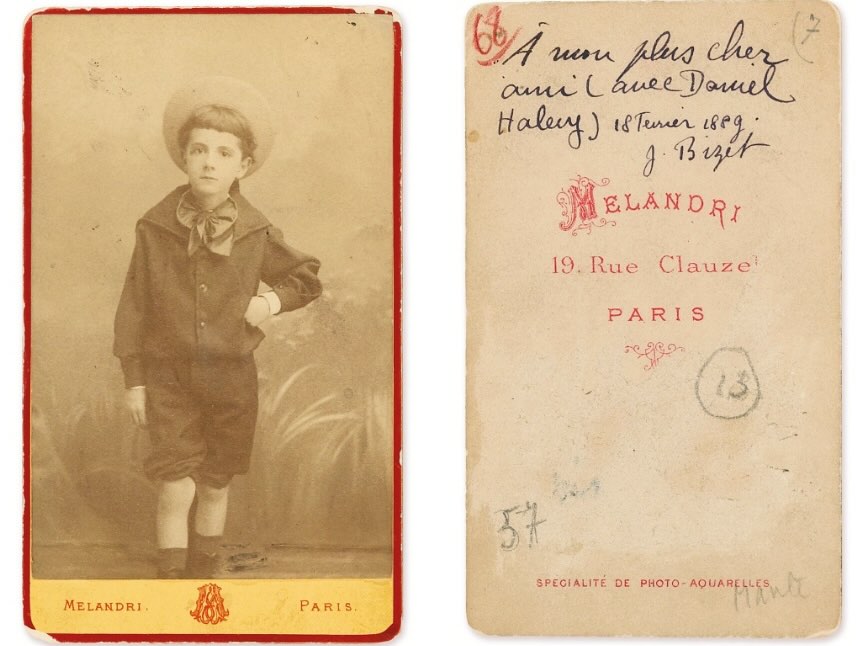
Jacques Bizet is a sort of Proustian alter ego.
Translated from French.
Jacques Bizet is a sort of Proustian alter ego. 👦🏻👦🏻
The son of the composer Georges Bizet 🎻 and Geneviève Halévy, Jacques Bizet became friends with Proust at the Lycée Condorcet, although they had already met whilst attending the Cours Pape-Carpentier. 🏫
As a teenager, Marcel Proust experienced his first great romantic passion ❤️🔥 for Jacques Bizet… who rejected him in a friendly manner 💔. He then met her young mother, Geneviève Halévy, the widow of Georges Bizet, who had remarried Mr Straus. Marcel Proust also fell “in love” with her. ❤️🩹
Like Proust, Mrs Straus is in poor health 🫀🫁; like him, she is witty and highly cultured 🧠. Both have ties to the Jewish faith but are agnostics, and they are in favour of a retrial in the Dreyfus affair. Madame Straus was one of the models for the Duchess of Guermantes, but also, no doubt, for Madame Verdurin. Marcel’s letters to Madame Straus were published by @editions1018 in 1994. 📚💌
As for the famous portrait of Jacques Bizet as a young holidaymaker wearing a boater hat, it was painted by Jules-Élie Delaunay (1828–1891), a painter born in Nantes, in 1878, and is on display at the @museedartsdenantes. Winner of the Second Grand Prix de Rome in 1856, Delaunay spent four years at @villa_medici 🏛️ and is buried in Nantes. He therefore painted the portrait of two of ‘Proust’s loves’: Jacques Bizet and his mother, Geneviève Halévy, widow of Bizet. 💕
A doctor and businessman, Jacques Bizet became the director of the Unic Taximeters company 🛺, founded in Monaco by the Rothschilds. Alfred Agostinelli was working for this company when he became Marcel Proust’s chauffeur in Cabourg in the summer of 1907. ⛱️
In 1909, Jacques Bizet founded the car company Le Zèbre 🦓. Having lost his father, he was also bereaved by the death of his first wife and went on to enter into a second, unhappy marriage. Having become addicted to morphine 💉 and an alcoholic, he took his own life on 3 November 1922, 15 days before the death of his childhood friend, Marcel Proust. ⚰️🪦
#JacquesBizet #MarcelProust #proustagram #LeZèbre #TaximètresUnic #Rothschild #JulesÉlieDelaunay #GeorgesBizet #MmeStraus
As for Proust, Daniel Halévy’s diary states that he died on Saturday 18 November 1922 (he learnt of this the following day by telephone) and that at his funeral on Tuesday 21 November 1922, during the service at St-Pierre de Chaillot, there were “Too many drapes, too many candles, too much music.” Around two hundred people then gathered at Père-Lachaise: “Not many people, all in all.” (pp. 155–156)