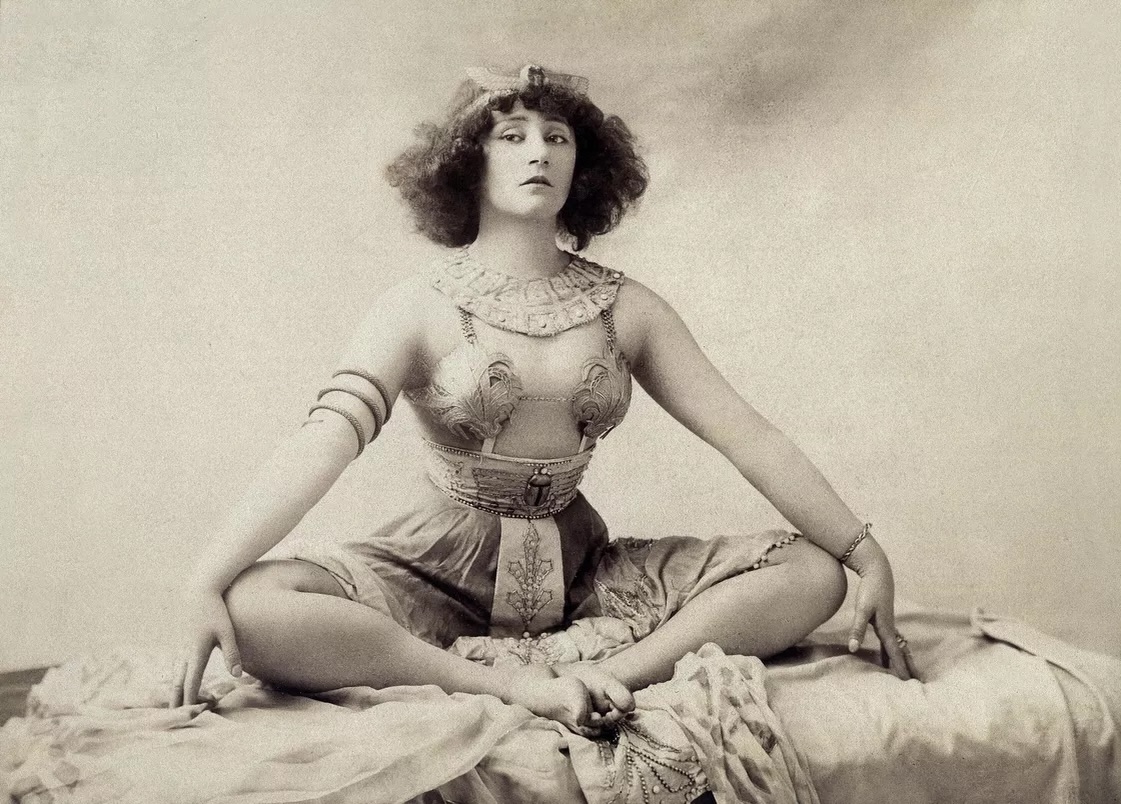
In 1910, Colette 🤵🏻♀️ managed to leave her first husband, Willy: “Eight years of marriage, three years of…
Translated from French.
In 1910, Colette 🤵🏻♀️ managed to leave her first husband, Willy: “Eight years of marriage, three years of separation: that makes up a third of my life.” She embarked on a career in dance and pantomime, showcasing her talents wherever she went – from cabaret to theatre, and from theatre to casino. 💃🏻
It was probably not considered very respectable, during the so-called Belle Époque, to be a divorced woman in her thirties with no children, who either covered or revealed her body on the stage 🎭. And Colette was well aware of this:
🖋️ “But what do you expect me to do? Sewing, typing, or working the streets? Variety theatre is a job for those who haven’t learnt any other trade.” 🤷🏻♀️
Admittedly, she is the author of the hugely popular “Claudine” series 📚, but it is Willy’s name that appears on the cover. And before “La Vagabonde”, Colette had not yet been fully recognised for her literary talents. She began writing columns 🗞️ – short pieces for her own account – which she compiled in 1908 into the collection “Les Vrilles de la vigne”. But “La Vagabonde” is something else entirely: a novel and a diary 📝, a reflection on the self, on the artist’s lot, on the condition of women, and on love too – including through letters exchanged between Colette’s fictional alter ego, Renée Néré, and a certain Max Dufferein-Chautel. 💔
In 1906, having begun an intimate relationship with Missy (Mathilde de Morny), Colette left the marital home and embarked on a career in the theatre. But in 1910, despite her obvious loathing for her first husband, she published “La Vagabonde”… under the name ‘Colette Willy’ ✍🏻.
In the summer of 1907, Marcel Proust, a contemporary of Colette (along with Gide, Valéry, Léautaud and Claudel, they belonged to the ‘generation of 1870’), began writing what would become “In Search of Lost Time”. 🕰️
Like “The Fugitive”, “The Wanderer” is the story of a breakdown ⛓️💥. But it is also a unique account of an extraordinary life: that of an artist in the 1900s.
🗳️ And what about you – have you ever read Colette?
And I also love “Chéri” and “La fin de Chéri”, and “La Seconde” and “La Chatte”… oh, I almost forgot “Julie de Carneilhan” and its joyful melancholy