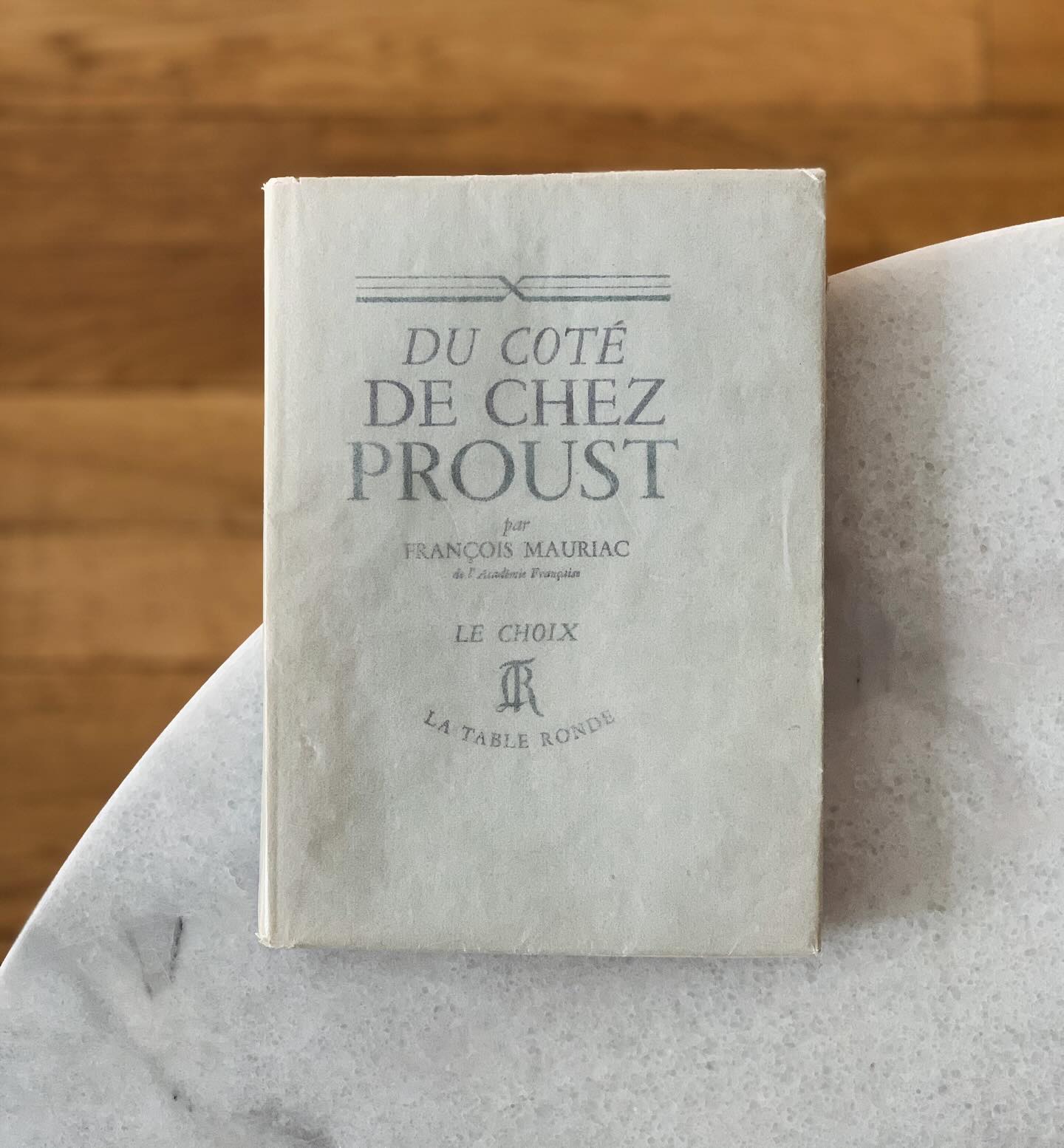
François Mauriac (1885–1970) 👨🏻🦳, winner of the 1952 Nobel Prize in Literature (@nobelprize_org), moved in certain circles in his youth…
Translated from French.
François Mauriac (1885–1970) 👨🏻🦳, winner of the 1952 @nobelprize_org in Literature, frequented in his youth the Parisian salons that Proust had frequented 15 years earlier. As soon as John Ruskin’s book “Sesame and the Lilies”, translated and with a preface by Proust, was published, Mauriac said he had been in awe of the depth of Ruskin’s analysis of reading:
🖋️ “From the very first lines of this preface, I felt as though I were on the border of an unknown land. (…) a sort of daze.”
In 1913, he bought (as he put it) one of the few copies of “Swann's Way” 📗, published at the author’s own expense by @editionsgrasset, from a bookshop. He would not meet Proust until the final months of the war:
🖋️ “I met Marcel Proust for the first time at the end of the war, at Mrs Alphonse Daudet’s house, on 3 February 1918, during a reception held in honour of Francis Jammes.
(…) He struck me as rather small, hunched over in a very tight-fitting coat, his thick black hair casting a shadow over pupils that seemed dilated by drugs. Tucked into a very high collar, his chest thrust out as if by a sternum, he fixed me with a nocturnal gaze whose intensity intimidated me.”
One evening, Proust, from the comfort of his bed, welcomed Mauriac 🛌 for an evening of literary discussion and friendly conversation. A few letters were sent 📬, and books were presented as gifts and signed.
This volume brings together, under a somewhat conventional title, the various texts Mauriac wrote about Proust, including “At Proust’s Grave”, already mentioned here (see Featured Stories 📺). But in each of these texts, including the eulogy, Mauriac cannot help but veer from admiration to a condescending, even contemptuous, tone. Above all, he criticises Proust for not having devoted his life and work, as he himself had done, to God 🙌🏻:
🖋️ “(…) the lack of a moral perspective impoverishes the humanity created by Proust and narrows his world. Our friend’s great mistake (…) is what we might summarise in a single word: the absence of Grace.”
What do you think: does this statement by Mauriac seem justified to you, or does it stem from a lack of discernment? 🤷🏻♂️
Over at Proust’s, @edlatableronde 1947
Grimaldi makes it clear that love (with a few notable exceptions) is present in the novel only as a pretence. Girard says much the same thing with his theory of mimetic desire. As for Gracq, he observes that Proust seems to lie in wait for his characters, ready to strike them down at the edge of the grove.
That said, this absence of Grace is embraced. For Proust, it is a sign of intellectual courage (cf. Deleuze, who emphasises the Nietzschean influence on “In Search of Lost Time”), something of which Mauriac unfortunately seems to lack.
How can one bear the absence of grace, the tragedy of incommunicability and misunderstanding, the distortions of the imagination, and the misinterpretations of interpretative signs? How can one salvage something from the wreckage of oblivion, how can one repay one’s debt of gratitude for the immeasurable love of one’s mother and grandmother?
One must grapple with these questions, one must confront this absence of Grace and endure the silence that precedes the creation of a novel in order to understand and fully appreciate the immanent illumination of art.
The ‘grace’ with a small ‘g’ in Proust’s work is more subtle than that to which Mauriac – who understood nothing – alludes. And one cannot blame him for this: not everyone has the courage to face the trials of “In Search of Lost Time”. Some people need a Grace that is bestowed unconditionally upon the weak-minded, the lost and the blind. And it is comforting to place this gift amongst the clouds of transcendence. Proust has the courage to situate his own grace within the realm of human affairs. This is not to say that there is not, at times, a higher order of things which the narrator receives and to which his art pays homage (rather than presenting himself as a demiurge): a mother’s unconditional love, the clarity of aesthetic enlightenment, and the understanding tenderness towards human beings who struggle amidst error and misery before plunging back into nothingness.